

Here are some things I think I am thinking about.
1) The Price of (Un)Certainty.
If you missed our newest research piece on where markets are I think you’ll like this one, especially given the recent volatility. What I did in this piece was price out real TIPS yields over time and discuss the trade-offs you have to make when considering them. After all, with TIPS yields at all-time highs you can lock in a guaranteed 3% real return. That means that if inflation averages 4% for the next 30 years you’ll get a guaranteed 7% nominal return on a risk free instrument. That’s pretty damn compelling in a world where nominal 30 year bonds are yielding 5.3% and stock valuations are high. But what are you giving up along the way? I typically like to match long-term liabilities to equities even though the range of outcomes is wider. But the range isn’t just wider. It’s asymmetrically skewed to the upside by a very large margin. Stocks don’t typically beat TIPS. They typically beat the pants off of them and the compounding effect over 30 years is gigantic. But with valuations are all-time highs the math there changes a bit.
Anyhow, I priced out the whole curve on both a historical and forward looking basis to offer some perspective about the menu of current options and how an investor should think about this in the context of today’s uncertain markets. The conclusion is that certainty is cheaper than its been in a long time because real yields are so high. But that doesn’t mean the potential opportunity cost has gone away. And that’s where the debate gets interesting because my general conclusion is this:
a. If you need a lot of certainty in your financial plan you should consider more TIPS and TBills at current yields to lock in the guaranteed certainty. You might even consider going much further out on the yield curve with TIPS than you otherwise would.
b. If you don’t need a lot of certainty you should lock in your short-term needs with TBills and short-term TIPS and then layer in equities as you go out the curve. Even with high valuations the equity investor who buys a globally diversified portfolio at current valuations has a good probability of beating long-term TIPS by a healthy margin.
Check out the full note here. There’s a summary piece as well in case you don’t have time for the full paper.
2) & 3) When volatility comes home to roost.
I am actually folding a bunch of thoughts into two things that are really like a hundred things. I hope it all makes sense in the end.
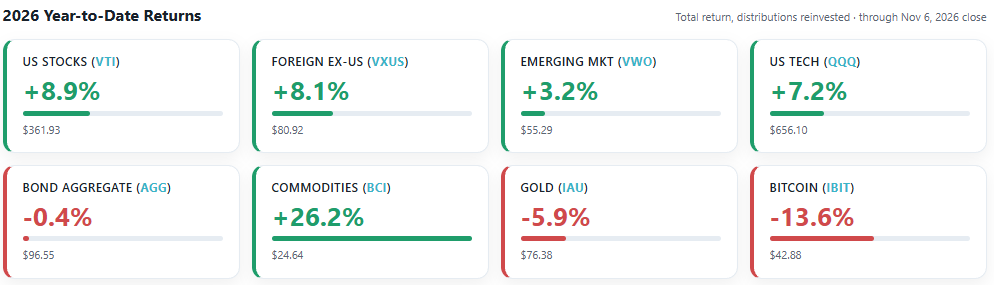
Stocks are long-term instruments so I always hesitate to talk about their short-term movements, but in weeks like this some perspective is helpful.
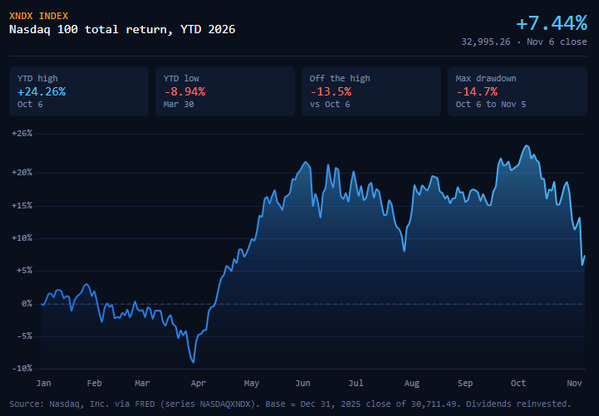
Markets got very volatile after the mid-term elections this week. As of October 3rd the Nasdaq 100 had been up over 24% year to date. As of yesterday’s close it was up just 7.4%. This week was exactly why I was surprised that the Iran war was allowed to persist this long. I figured it was common knowledge that the longer this war lingers the longer gas prices would remain high, which would boost inflation and destroy public sentiment leading to a loss in the mid-terms. So, ending the war before the end of Summer was an absolute necessity if you wanted to win the mid-terms. That obviously didn’t happen which is why we ended up with the interest rate shock last month. So none of what happened this week is all that surprising (except for the fact that it was allowed to occur), but what is surprising is the way the elections actually unfolded and the way markets digested it.
Tuesday was a weird night. On a national level you had some truly shocking Democratic wins. You might be so inclined to say it was the biggest Democratic victory ever. But under the hood the country didn’t move as far left as you might think as California shot down the wealth tax and did so in convincing fashion as it nuked prop 40 and prop 42, which banned future wealth taxes. Then again, the country convincingly voted against future data center construction as 43 of the 44 data center construction proposals got rejected. It was a decisive loss for technology and AI.
I don’t think the public sentiment on AI is totally justified. I just don’t see the negative impact on human life so far. Sure, electricity prices are up 4.5% year over year in the CPI and that’s largely attributable to AI data centers, but the bump in inflation this year is almost entirely due to oil and gas, not electricity. And on the jobs front, the negative impact is hardly noticeable. In fact, we got a pretty good jobs report on Friday. My view is actually negative in the long run here, but it’s mainly a robotics story. The days to get worried are when robots replace all the manual labor across the economy. When you start seeing robots on construction sites then that’s the time to get scared about jobs. But that’s still a ways off and yes, the regulations there need to be strict. But limiting data centers over fears of AI is like limiting a desalination plant construction because you’re worried about the water being dirty in your house. Those are two different jobs done at two different points on the water delivery chain. Likewise, data centers aren’t the enemy. The enemy (and the information endpoint they rely on) will be the robots that ultimately use that information to take over the jobs at the point of use. So far, we’re just not seeing the big bad negative impacts. In fact, AI investment is one of the few things boosting GDP in a world where high interest rates have nuked real estate market investment. Is some fear warranted? Yes. But the data centers aren’t the enemy.
All of which brings me to this piece which was circling last week about how high AI unemployment could eventually crash the stock market. The argument is if AI pushes unemployment toward 10% and the job losses hit high earners this time, retirement plan contributions into stocks could drop. The author estimates DC plans and IRAs put about $478 billion into US equities in 2024, with something like $200 to $300 billion coming from higher earners. A 10% to 50% hit to that flow would take $20 to $150 billion a year out of the market.
This is compelling, but again, I don’t think we have an impetus for 10% unemployment unless robots come online much faster. We’re just not seeing the job displacement from the software itself. In fact, my gauge is that the software is making white collar workers MORE productive so firms are slowing their hiring, but getting more out of their existing workforce. The recent weakness in 2026 labor reports isn’t a net drag on labor. It’s an indication of more caution and a slowdown, not a collapse.
But let’s say I am wrong and the losses start piling up. What happens? Well, the first thing that happens is a whole lot of people start getting unemployment benefits. So the lost jobs aren’t 1:1 lost aggregate demand. The government fills that gap as corporate margins expand from the productivity boost. We know government deficits ultimately flow to corporate profits so much of this depends on how much the government will backstop the job losses and how quickly they do so. If Tuesday is any gauge, I’d say the near-term risks of a loss in aggregate demand from AI just fell a lot because a Democratic government will almost certainly be more inclined to fill the void from AI job losses. But more importantly, the mechanism for the market losses appears massively overstated here. The author’s worst case scenario of $150B is tiny in an equity market that is $60 trillion. Sure, retirement plans are an important driver of equity demand, but they’re far from the most important one or even an essential one.
Another interesting thought in all of this is if public sentiment is so negative about AI then how can we be in an AI bubble? Sure, valuations are up a lot, but if public sentiment is the gauge then the only optimists about AI seem to be people in Silicon Valley and Wall Street. The rest of the country hasn’t caught up yet. And if that’s true then we might be a lot earlier in this bubble than people think. I don’t time bubbles though so I don’t have a view on that specifically, but it’s an interesting thing to consider in the scope of such negative sentiment.
All that said, I do think certain investors need to be very careful about AI exposure and it’s times like this where our Defined Duration ALM strategy really shines. In our research piece from last month we wrote about how high valuations extend the sequence risk of certain instruments. High valuations don’t necessarily mean lower short-term returns. They mean the time horizon over which those returns materialize could take longer than you expect. That is exactly what we’re seeing in technology right now. The highest valuation sector is acting like a very long duration and very volatile instrument. This is why ALM is so powerful. When you compartmentalize things across time you can specifically delineate your exposures to certain things. Tech stocks are 30+ year instruments in this strategy. If you’re using them to fund your short-term needs then you’re in a world of hurt right now. You created an asset-liability mismatch. If, on the other hand, you have 2 years of expenses in TBills and 3-5 years of expenses in TIPS then none of what’s happening in tech matters to you. You don’t have a mismatch in your portfolio so you don’t have to worry about what a 30 year instrument does in a 30 day period. This is the beauty of ALM. It’s not just a behavioral buffer in bad times. It’s allowing you to have your cake and eat it too. You can comfortably own stocks (even the most aggressive stocks) AND literally eat your cake from the near-term assets you hold while the baker bakes more cake in the background over time. This gives your stocks time to recover while you consume short-term assets. This isn’t just behavioral finance at work. It’s sound financial planning.

But that’s perhaps the most important lesson I’ve learned in all my years of portfolio management. Having good behavior and a sound financial plan is great. But what keeps it all together is a good process along the way. And that’s probably the most elegant piece of ALM. It’s not just a behavioral tool – it’s a structure that you can derive specifically from a financial plan. You don’t put together the portfolio thru guesswork about market efficiency and asset optimization. A good ALM allocation just falls out of the liability math and you don’t argue with the math along the way because the math is what keeps the portfolio process structured through bull and bear markets.
Well, that’s all I’ve got for you this weekend. I hope you’re hanging in there with this volatility and that you don’t have an exposed asset-liability mismatch that’s keeping you up at night. As always, stay disciplined out there.
NB – Halloween was certainly scary this past weekend. My daughters nailed the Wednesday Addams look. My Gomez look was sketchy. A few people asked me if I was Travolta from Pulp Fiction. Sure, but I would have botched that one also, especially if you asked me to dance.