

We're helping investors solve their most important problem - TIME.
The future of investing and financial planning is here.

Defined Duration, at a glance
Defined Duration Investing (DDI) is a rules-based framework that organizes assets around the timing and predictability of liabilities and expenses. We quantify and then match the defined duration (i.e. ‘how long your money is committed’) of your investments to your goals, rather than using guesswork or style boxes, thereby making financial planning more structured and easily understood.
1 · Plan
We build the financial plan based on a rigorous assessment of your balance sheet and income statement strength.
2 · Quantify
We use our custom software to quantitatively assess your risk score and financial strength based on empirical inputs, not subjective emotions.
3 · Match
We use our Defined Duration™ methodology to assess the right assets to match your financial goals and customize the right portfolio for you.
4 · Maintain
We maintain your plan over time—rebalancing and updating goals as life evolves.
How the Defined Duration™ method works
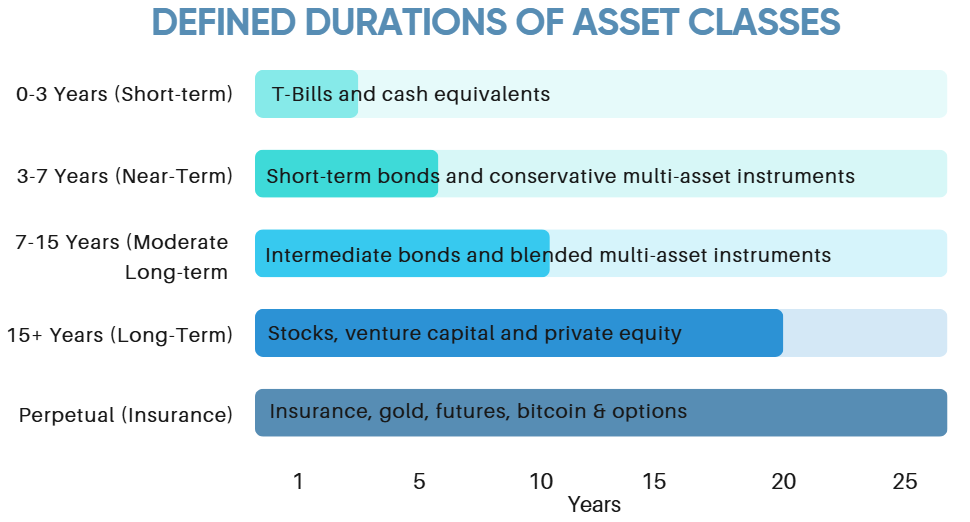
We map out your financial plan over 5 structured time zones to quantify your expenses and liabilities across your life. We then match them to assets using our quantitative Defined Duration methodology. For example, in the Defined Duration methodology cash is a 0 duration instrument. Bonds are typically 3-7 year instruments. And stocks are 15+ year instruments. This methodology allows us to build a temporally structured portfolio where the assets are matched to specific expenses and liabilities across time. The portfolio is customized based on your financial plan and structured using low cost, tax efficient and simple instruments designed to give you a clear understanding of how your assets correspond to your goals and financial plan.
Short-Term (0–3 Years)
Cash & short duration instruments for upcoming withdrawals and emergency needs.
Near-Term (3-7 Years)
Safer assets such as high quality bonds to match expenditures in the 3-7 year time horizon.
Intermediate-Term (7–15 Years)
A blend of growth and principal stabilizers (for example a multi-asset instrument like a 60/40 stock/bond fund) to match the uncertain period in the 7–15 year range.
Long-Term (15+ Years)
A blend of aggressive growth assets such as stocks to maximize growth and protect you from inflation.
Perpetual (Unknown)
Insurance-like assets to help cover your financial plan in case of the unknown.
From the old way to the new way
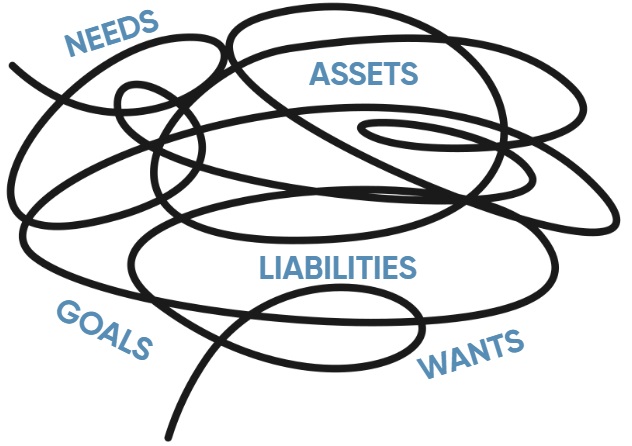
Product-first, subjective, costly. Unclear goals, style boxes and factor tilts, frequent changes, and little linkage between assets and real-life spending.
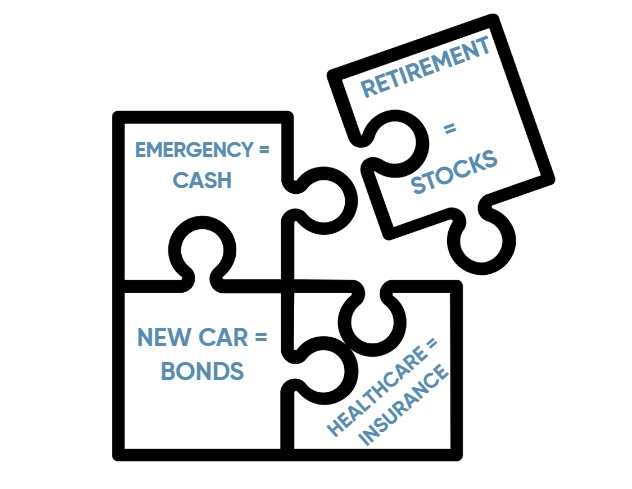
Planning-first, quantified, disciplined. Clear goals, objective profiling, low fees, and time-mapped sleeves that align assets to liabilities.
Tools that make the process systematic and quantifiable.
Quantify, visualize, and communicate the plan with clear, repeatable outputs.
HourglassFP Pro
Our customized asset-liability matching, profiling and portfolio construction tool.
The Defined Duration Tool Suite
Refine your plan with our customized retirement, estate and investing tools.
Plug and play products
Use the Discipline Funds product line to plug and play options in your plan.
Implementation options
Choose how to implement the strategy for yourself.
Do It Yourself
Work through the HourglassFP Tools yourself and plug and play the right pieces.
Work with your own advisor
Work with your own advisor to have them implement a Defined Duration™ portfolio.
Research & education
Research and ongoing insights to support planning-first fidelity.
Whitepaper: Defined Duration™ Investing
How Investors can Improve Financial Planning Needs and Portfolio Performance Using a Defined Duration Strategy.
Video: What is Defined Duration™ Investing?
COMING SOON - Learn how we apply the Defined Duration™ Method.
Audio: Implementing the Defined Duration Framework
Listen to our Morningstar interview about how we apply the Defined Duration Investing strategy.
Frequently asked questions
What is Defined Duration™ Investing & how does it differ from traditional portfolio management?
Traditional asset management processes are broken. Over 90% of active managers underperform their indices over 20+ year periods and yet the financial services industry still promotes style boxes, factor tilts and other performance-based portfolio strategies as planning solutions. Worse, this creates performance-based expectations instead of planning-based expectations which leads to performance chasing, higher turnover (higher taxes and fees) and behavioral biases. Defined Duration flips this all around and starts with your financial plan and ends by aligning specific assets to specific expenses and liabilities using a rigorously quantitative financial planning process.
In the traditional portfolio construction process the advisor does subjective risk profiling and implements a portfolio that tries to optimize for style boxed risk/return to meet client needs. Defined Duration quantifies the risk profile based on quantitative balance sheet and income statement inputs and then applies an asset allocation based on the underlying financial plan and needs, not a subjective risk optimization process. This gives the client greater clarity of why they own certain assets and the way those assets are actually helping them achieve their financial goals. Best of all, it can be implemented in a low fee, tax efficient, globally diversified and highly personalized manner.
We've created a unique process by which we can quantify a reasonable time horizon for different asset classes. This allows us to quantifiably match specific assets to a specific financial plan. For example, in the Defined Duration methodology cash and T-Bills are 0 duration instruments, the bond market is a 5 year instrument and the global stock market is a 15 year instrument. We use this method to match and blend different instruments or alternatives to different liabilities and needs in the financial plan.
How is "Defined Duration" quantified?
Good financial planning requires some level of forecasting. We have to forecast future inflation, withdrawal rates, potential returns, etc. Defined Duration investing attempts to apply a reasonable time horizon to different asset classes so we can then match those assets to specific financial planning needs. We quantify this by estimating a potential sequence of returns risk applied to current market expectations of inflation and returns. This gives us a real break-even time horizon for potential asset returns which we can then plug into a financial plan for asset-liability matching purposes.
For example, let's say 5 year interest rates are 4% and future inflation expectations are 2.5%. If this 5 year bond has a modified duration of 4.5 and a real expected yield of 1.5% then this means that if interest rates rise by 2% (approximately a 9% shock to the instrument's price) that it will take about 7.08 years for it to break even in real terms. This is the instrument's "defined duration". This allows us to assess current market environments and apply an asset-liability matching process to the financial plan. This process can be applied across different assets as markets evolve and environments change to help planners assess reasonable time horizons to be applied to different assets.
Like all forecasting it will inevitably be imperfect to some degree, but with a reasonably conservative severeity assumption and reasonable forward looking return estimates we believe this process can quantify a realistic time horizon to assess certain expectations over which assets might perform inside a financial plan.
What is the Defined Duration of the stock market?
We quantify the defined duration of the stock market by assessing current market conditions (such as valuations), expected real returns and estimating the sequence of returns over time depending on an estimated drawdown risk. For instance, if US stocks have very high valuations and lower expected risk adjusted returns then they're more likely to expose us to higher sequence of returns risk. In other words, when stocks become very expensive they become longer duration instruments.
Different components of the global and domestic stock markets have different expected returns and risks. Our strategy tilts to different regions and styles depending on current market conditions. This will typically mean that when stocks are very expensive a shorter duration target requires reducing exposure to higher risk regions or styles. And vice versa. As an example of this, at present, US tech stocks are very richly valued against the rest of the US market. This might mean that a domestic defined duration strategy would require an underweight allocation in US tech if it is trying to achieve a lower average defined duration when compared to technology. We quantify this for different styles and regions in the global equity market and rebalance the portfolios depending on how the current defined duration matches with the specific instrument's target defined duration.
What instruments do you use?
We are huge fans of low cost indexing style strategies. We always try to use the lowest cost and most appropriate instruments to meet someone's needs. But we also know that one size doesn't fit all. On average, a Defined Duration portfolio will hold a custom T-Bill ladder and 5-10 stock and bond ETFs. Where appropriate we apply an insurance sleeve to insulate the investor from excess inflation and other risks, but the insurance allocation is 100% optional. But in all cases, diversification, low costs and tax efficiency are essential aspects of the products we utilize.
What does the portfolio look like?

In theory, our portfolios can be as simple as 3 funds across 3 time horizons, but our experience is that investors need more customization and greater diversification to meet life's varying time horizons. On average, the Defined Duration process will output 4-5 customized allocation blocks across the 0-3 year, 3-7 year, 7-15 year, 15+ year and perpetual time horizons. The instruments utilized within each bucket can be structured and customized to meet the granular goals of the underlying investor. While we tend to defer towards "simple is better" we also know that our financial lives are anything but simple and some level of customization is always required.
At a minimum you can expect to see a portfolio where the 0-3 year time horizon matches a personalized T-Bill ladder, 3-7 year time horizon matches intermediate bonds and safe multi-asset instruments, 7-15 year time horizon matches a balanced allocation of stocks/bonds, the 15+ year time horizon matches a more aggressive stock tilted allocation and the perpetual time horizon is matched to instruments that exhibit insurance like features (gold, managed futures, options, etc). It's all customized to match the client needs and so every portfolio is different.
How are risk tolerance and capacity incorporated?
We built customized software based on our methodology to help us implement a quantiative planning process. We anchor risk to balance-sheet strength and cash-flow needs, not emotional and subjective questionnaires or a portfolio manager's guesstimates about the best stocks. Everything about the Defined Duration method is rigorously quantitative to reduce subjective and emotional inputs. This helps us create a portfolio based on your balance sheet robustness, not your emotional fragility thereby helping us build a portfolio that can ride out any storm knowing that we all become fragile when markets get volatile.
How does DDI reduce sequence of returns risk?
Sequence of returns risk is the risk that your financial assets won't give you liquidity when you most need it. For instance, someone retiring in 2007 with a very aggressive allocation of 80% stocks and 20% cash would have found themselves drawing down their cash allocation at the same time they see their total portfolio balance fall over 40%. This creates the risk that the investor has to sell into a downturn or worse, consider going back to work to bolster financial certainty. DDI is designed to reduce sequence of returns risk by creating a more consistent asset-liability match across your financial plan. This is achieved by creating a proper allocation based on balance sheet and income statement robustness and ensuring the assets owned are aligned with the expected expenses and liabilities you will encounter across life. Because the assets are temporally structured this creates a higher probability of financial success.
Good asset allocation doesn't only require diversification. It requires temporal diversification as well because being diversified doesn't mean you're insulated from temporal risks. For instance, an investor owning a 60/40 stock/bond allocation that was comprised of 60% stocks ETFs and a 40% aggregate bond market fund, might have thought they were diversified until 2022 occurred and both components fell significantly at the ame time. The investor in this allocation found themselves at the mercy of a very negative sequence of returns because they were not temporally diversified. This is because they owned a portfolio of mostly long duration instruments as an aggregate bond index has significant moderate and long interest rate risk and stocks are inherently long-term instruments. Had this investor been diversified across more time horizons they would have insulated themselves from this risk by giving themselves more temporal optionality across their portfolio. For instance, they could have owned 60% stocks, 20% bonds and 20% T-Bills and they would have enhanced their portfolio by adding shorter duration instruments. This is the essence of good asset-liability matching and the Defined Duration strategy - by matching assets to liabilities and broadening our temporal diversificaiton we reduce sequence of returns risk across time.
This is the power of temporal diversification and why DDI can enhance certainty in asset allocaton.
How often are allocations reviewed or rebalanced?
Reviews are tied to plan changes and horizon shifts, with disciplined rebalancing policies to keep durations aligned. Every Defined Duration portfolio is different because every client is different. These customized plans require as much upkeep as the client needs. So the answer is, it depends! But we try to minimize rebalancing knowing that more activity can result in more taxes and fees. That's why we built our own set of products and software to help implement the Defined Duration strategy. These products are specifically designed to reduce activity and enhance customization by maintaining an asset allocation and process that better aligns with our goals.
Are you fiduciaries?
While we have our own customized products and software we also truly believe that this form of asset allocation is a better way to do financial planning and asset management. We didn't build this process with the goal of getting rich. We built this process with the goal of solving an obvious problem in finance - the problem of time. So yes, when we make recommendations we always try to do what's in the best interest of the people we are privileged to work with.
Ready to align portfolios to real-world plans?
Speak with our team or request an overview you can share with stakeholders.
Contact Us