

Markets got crazy this week. What should we do? Buy more? Sell it all? Is it bunker time? Is a recession coming? Is it 2002 all over again? Let’s talk about it.
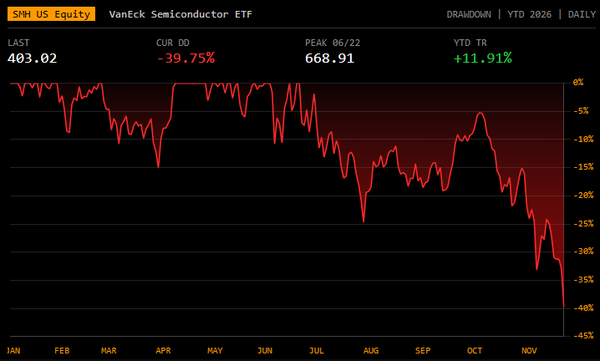
The wheels started to come off the AI trade this week. It’s an interesting thing to think about because this has to be the most predictable of downturns I can ever remember. I’ve been talking about tech as a very risky and super long duration instrument for years now. In our recent piece on valuations I discussed how investors needed to be careful about tech exposure because the Defined Duration of technology was exposing portfolios to excessive sequence risk. And boy, that sequence risk didn’t just knock on the door this week. It kicked it right down. Figure 1 shows the semiconductor index since the Summer high.
Yes, you read that correctly. That’s a 40% drawdown and the index is still up 12% this year. Amazing stuff. But again, as I’ve said many times in recent years, high valuations are high expectations and when those high expectations disappoint you get big volatility because the margin for error is so slim. It’s interesting in the context of semis because you still have a high annual return, but the sequence risk of the returns just got really messy. So here we are. Expectations are adjusting.
The question now is how much of this is a real economic downturn versus an expectations disappointment because those two things are very different. A revaluation from very high expectations is a good thing in the long-run. That is just a market that recalibrates to a more sustainable baseline. The stock market cannot and should not only go up. It’s a constant give and take across a long-term price discovery path. And that is consistent with your standard correction and short-term bear market which is the market adjusting in the short-term in the process of a longer bull market. A revaluation due to real economic downturn is more troubling because you get a revaluation of prices that is not just psychological price discovery, but a fundamental adjustment to a changing economic regime. Downturns like this become self reinforcing and more sustained because the price discovery process undergoes a much longer and uncertain adjustment as the broader macroeconomy recalibrates. This is where sequence risk shows up and it’s why market downturns like 1929, 1973, 2000 and 2008 lasted as long as they did.
One thing we know about today’s environment is that the downturn is mostly AI driven. We can see this in the dispersion of returns from something like the equal weight index vs the Nasdaq 100. Equal weight is down 7.85% from its peak while the Nas 100 is down 20%. That makes sense because the concern right now is not so much about the broader economy, but AI’s impact more specifically as investors digest how much economic impact will materialize from a reduction of AI investment in the future. The question, as we’ll see here shortly, is whether this spreads like a virus into the broader economy.
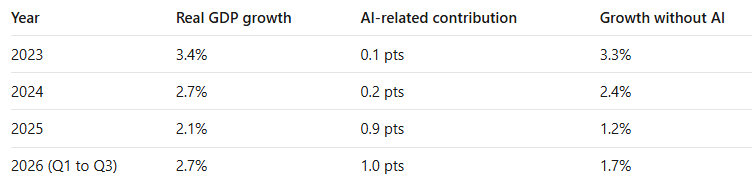
Here are my estimates of how this has looked in recent years. As you can see, AI is doing real work in the economy now. Without it we’re growing 1-2%. But the bigger economic worry is the outlier effect of the stock downturn and the wealth effect and then whether the Fed tightens the screws at the same time. A reversal in AI spend doesn’t have the derail the economy, but a negative wealth effect with a tight Fed certainly could.
I’ve put together three general scenarios that could play out from here:
1. AI spending plateaus. The roughly 1 point gross boost goes to zero. Imports fall too, so the net hit is more like 0.3 to 0.7 points. Growth slows to around 1.5% to 2%. That’s painful for tech earnings but not a recession.
2. AI spending gets cut 20% to 30%. The boost turns into a drag, and GDP growth takes a 1 to 1.5 point hit. Growth falls to around 0.5% to 1%. That’s stall speed, and the risk of a recession goes up a lot.
3. The wealth effect adds to either one. Total lost market value is at about $8.5 trillion from the peak. A common rule of thumb is that households cut spending by a few cents for every dollar of stock wealth they lose. If that holds, this hit could cost another 0.5-0.75 points or so of GDP over the next year or two, mostly from upper-income households. This is essentially your 2002 downturn. You don’t necessarily get sustained negative GDP in that environment, but you’ll get enough of a bump in unemployment that the BLS will call it a recession.
There’s an important difference between the Nasdaq Bubble and the current environment though – the companies losing market value aren’t a bunch of profitless dotcom companies with no established business. In this downturn we’re talking about the biggest and most valuable companies that ever existed. They not only have gigantic revenues from AI, but their core businesses are also still very valuable. In 2002 the broader stock market got pulled down because tech fell a whopping 80%. But when we look at the current potential downturn in stocks I think it’s very unlikely that this turns into a 2002 level downturn where the broader market falls 40%+ because the drag from tech is unlikely to rival the same 80% downturn we saw during 2002. That’s a very important difference here.
There’s another very important factor in all of this – that thing called the Federal Reserve. And it adds a 4th scenario in all of this because the response of the Fed in the coming years could be very important.
Here’s the thing about the current state of Fed policy – I don’t think more hikes will hurt the economy much because the Fed basically froze the real estate market with anything over a 6% mortgage. Staying restrictive doesn’t hurt the economy, it just doesn’t help. BUT, rate cuts would have a huge impact here. If the AI slowdown spreads and GDP growth slows to 0% the whole environment starts to look a lot like the 2002 downturn. But one very important difference is if the Fed starts to cut and mortgage rates start to fall materially you’re going to see a big comeback in real estate. Real estate was booming in 2000 and when the Fed cut during the tech bust the impact was minimal. But in 2026 real estate has basically been in its own contained 3 year recession. So you’re going to have a very significant recovery in the economy’s most important sector if the Fed decides it wants that. And that would put a floor under any major market and economic downturn. That’s one of the weird thing about recent growth – AI has been the thing holding up growth during a real estate recession. So, if AI reverses and real estate recovers we could enter an environment where the opposite occurs and real estate starts to operate like the countercyclical offset to an AI recession.
All that said, I think there are some very important differences between this environment and the 2002 downturn. That doesn’t mean there isn’t continued risk or that the broader stock market couldn’t fall further, but the probability of a broad 40%+ decline that lasts many years looks unlikely to me. So far this is looking more like a healthy correction than a recessionary downturn. And if it turns into a real recession I suspect lower interest rates are going to have a far greater impact than they did in years like 2002 or 2008. But again, if the AI recession is looming then those long duration tech stocks are still exposed to further adjustment.
What’s An Investor To Do?
It’s interesting to think about sequence of returns risk in the context of all this. This is a concept that is typically only applied to retirement. That is the risk of a large stock market downturn right when you retire so you get a poor sequence of returns that causes a debilitating withdrawal rate. While retirees are especially sensitive to this, sequence risk is actually the thing all investors are ALWAYS concerned with. The 25 year old who contributes 100K to an investment plan is also concerned about the sequence of their returns. They can typically afford for their stocks to fall 50% right after they invest, but it’s not something they want to live through. So good investing requires a plan that always mitigates sequence risk relative to your behavioral and financial planning needs. Total return strategies try to do this, but most of them are little more than taking long duration uncorrelated assets and trying to time when those long duration assets will operate like short duration assets. That doesn’t mean total return strategies are useless. It just means they’re more likely to look like long(er) duration assets because the manager can’t sustainably turn a long duration asset like stocks or gold into a short duration asset like t-bills or t-notes.
Of course, our solution is asset-liability matching because sequence risk mitigation is precisely what temporal matching does. And I think the current downturn is a significant validation of the overall Defined Duration framework. Anyone who has 0-5 years of liquidity built into their portfolio is unfazed by this downturn. If you’re loaded to the gills with long duration tech this is very uncomfortable because you have a potential asset-liability mismatch in your portfolio. But the 25 year old worker who has 80% in stocks and 20% set aside for that house down payment and emergency fund is unfazed by this because they don’t need the 80% of stocks in the next 5-10 years. The retiree who blocked out 0-7 years in shorter duration instruments is unfazed by this because they can ride out a very long stock bear market before they ever need to fund their portfolio from multi-asset instruments or stocks. There’s no reason for these people to become forced sellers of stocks. So on and so forth. Compartmentalizing your assets relative to your liabilities isn’t just a cute strategy run by pensions and banks. It’s a comprehensive investing process that works because it matches to a liability driven plan rather than constantly trying to optimize the assets in a world that is wholly unpredictable.
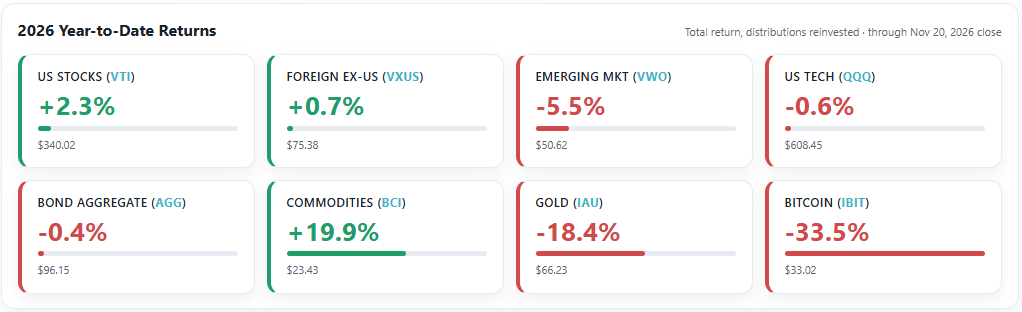
This is especially true in the context of total return strategies, which rely on asset optimization across different types of assets. The problem is, almost everything is falling simultaneously. Gold is down 35%, Bitcoin is down 40% and even managed futures are off 6%. So, even the things I refer to as “insurance” are down. The very best hedge this year hasn’t been gold, Bitcoin, long duration bonds or any alternative. It’s been short duration assets like Tbills and T-notes. If you didn’t have a temporal hedge in your portfolio in the last 12 months you’re most likely in a significant amount of total pain right now because every long duration is now either negative for the year or in the middle of a drawdown (long duration bonds have done slightly better of late, but are in a crushing long-term bear market and still negative on the year). This is what ALM is all about. It’s not about optimizing the assets and trying to time when a 30 year bond or other long duration asset will hedge your portfolio in the short-term. It’s about knowing that if you have any short-term need the ONLY instrument that can consistently immunize that liability (or behavioral need) is a well matched short duration asset.
I think our recent research piece “The Price of (Un)Certainty” is more important than when I published it a few weeks ago. Real rates are still 3%+ and investors who need certainty can still lock in certainty going out decades. But again, it all depends on your personal needs. The investor who needs certainty has better options today than they have in a long time because TIPS and shorter duration nominal bonds look so attractive. This also makes multi-asset instruments like 60/40 incrementally more attractive because the 40% piece can do real hedging now. And if equity valuations fall further you’ll start hearing me talk about how long duration assets just turned into short(er) duration assets that make them much more attractive for a longer-term statistical matching process. But that’s the thing about ALM – when time is your whole strategy you don’t have to worry about timing the market because your portfolio changes aren’t about turning water into wine (long duration assets into short duration assets). It’s about turning a dial when your plan changes and then considering which temporal asset is the appropriate match at that time.
Well, that’s all I’ve got for you this weekend. I hope everyone is hanging in there and as always, stay disciplined.
NB – The Return of Show Us Your Portfolio. If you didn’t see this already I’ll be the new host of “Show Us Your Portfolio” on the Excess Returns YouTube station. We had the one and only Meb Faber on for our first interview (you can watch here). I hope to turn the interviews into a real life version of my book, Your Perfect Portfolio, where we interview different types of investors and I probe them on how they build their own perfect portfolio. I hope we all learn a lot from it.