

Here are three things I think I am thinking about this weekend: jobs, bonds and tools.
1) Is AI Now Killing Jobs?
Well that was a weird employment report on Friday. Actual payrolls came in at 29K against a 90K forecast. The unemployment rate bumped up to 4.2%, from 4.1%. And wages were incredibly soft at 3%. But a lot of the softness came from government payrolls at -29K. And a lot of the underlying metrics I like to follow (like long-term unemployed, temp help services, etc) were pretty mixed. I can’t say that there was anything all that conclusive in the report.
To me, this report felt like more of the same we’ve seen for the last few years. The labor market is soft, but not collapsing. And I think that’s where the underlying data gets more interesting because the actual sectors where jobs are now coming from is starting to show signs of weakness in the sectors where you’d most expect AI to impact things. Sectors like information, finance and professional services are weak while specialty trade is strong. For now, that’s the “plumbers are safe from AI” trend while white collar workers appear more at risk.
I’ve been saying this for a long time and I still think it’s right – what’s happening here is that the firms in these sectors have gotten more cautious about hiring. They’re not firing people en masse, but they’re not hiring aggressively either because they are now able to get a little more out of the workers they have. I don’t think this has to turn into a scenario where mass firing results, but it’s definitely putting a ceiling on how much hiring can be done at this point.
Overall things look soft in the labor market, but still nothing that’s deeply alarming. And that’s consistent with what I continue to see in our FICA tracker as well. There’s actually been a little bit of a positive bump in the last few months so maybe things are picking up a little?
2) Bond Risk has Changed Materially.
With all the fear mongering around bonds at present I went ahead and updated our interest rate simulator tool recently. This thing is pretty cool. You can input different types of bonds, rates, scenarios and see how the bond return plays out over time. It’s all fed with real-time data and allows for a pretty customized simulation of different scenarios.
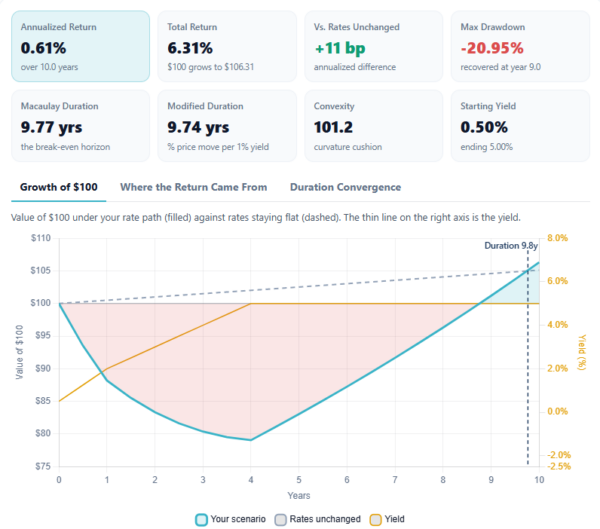
For instance, if you plug-in the 2020 scenario you can see how different today’s rate environment is when compared to then. In the simulator you can input custom waypoints to run a specific scenario. And here’s how the 2020 rate hike scenario played out for a 10 year T-note coming off 0.5% rates and going to 5.5%. It’s nasty, as we all know by now. Now plug in the same 5% change in rates where rates start at 5.5% and go to 10.5%.
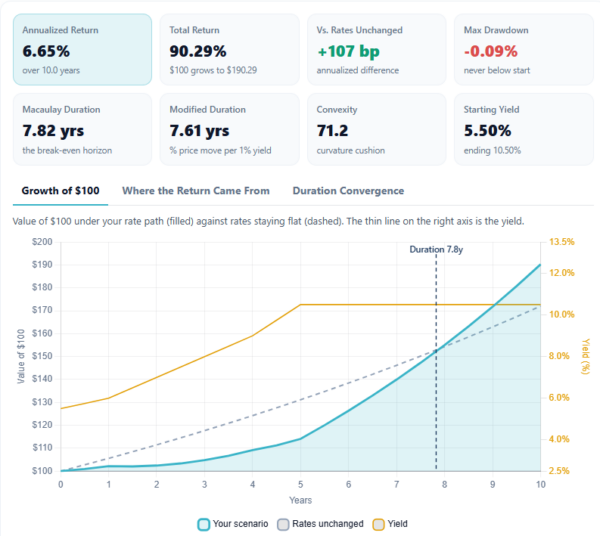
As you can see the nominal path is completely different because you’re starting from a high yield and ending with a yield that is actually in escape velocity (yield higher than modified duration). Of course, your real return was still low, but you didn’t have nearly the principal instability that you did coming off 2020 because the starting rate insulates your sequence risk better. And of course, the real yield issue is easily solved today because TIPS yields are so attractive.
Speaking of escape velocity, it’s reached about 6.16 years as of Friday. That means marginally longer durations are getting more and more attractive here. I still wouldn’t go out too much further than that, but this is a bond environment that is starting to get a lot more attractive so be careful buying into too much of the fear out there.
Speaking of fear, I also wrote a research piece debunking some of the bad narratives around all of this. Oh and then I updated an old piece of mine titled “Do Savers Deserve a Risk Free Return?” This is one of my favorite theoretical questions because you always hear people complaining about how low rates screw over savers. But then those same people are typically the ones saying that high interest rates are causing an unsustainable spiral in government debt. And the whole thing seems to confuse the fact that interest rates are little more than a policy trade-off trying to influence inflation. But more importantly, navigating all of this is little more than a temporal trade-off. 10 years ago my conclusion was that savers don’t deserve a risk free return. But that was before I’d modeled out the Defined Duration ALM process and so I wasn’t making the direct temporal link to the conclusion. And that’s what this is really all about. As I said in the updated piece:
“This was a footnote in the original, but it should have been the whole point of the 2016 piece. Savers who got hurt by low rates weren’t victims of the Fed or banking system. They were holding zero-duration assets against long-duration goals. Someone with a 20-year retirement horizon sitting entirely in T-Bills was always going to have a problem. Zero rates just made the problem obvious.
If you match your assets to when you actually need the money, the rate on cash matters a lot less. Short-term needs go in short-term instruments, where certainty is the whole point. Longer-term needs go in assets with longer durations and higher expected returns. Rate cycles will come and go based on policy choices you can’t control. Your time horizons and liabilities are something you can control.
So no, savers don’t deserve a risk free return. But savers who allocate by time horizon never needed one.”
This is so important because if you had savings in cash in 2015 and didn’t need the cash for whatever reason then it should have been getting ploughed into longer duration assets. Systematically sitting on cash you don’t need is an inherent mismatch and allocating to longer duration assets like equities was the difference between protecting your purchasing power and watching cash eat it alive for 10 years.
3) The Quick ALM Builder.
The most common pushback I get about applying asset-liability matching (ALM) to retail investment accounts is “but Cullen, retail investors don’t have predictable liabilities across time”. I think this is totally wrong. I actually believe ALM works better for retail investors than it does for institutions because a retail investor has more flexibility to use more assets in their methodology. When I used to work with bankers on these strategies I was always frustrated by how they had to use bonds to match long durations. This was mostly after the GFC and I was like “why are you matching 30 year nominal liabilities to a bond when we’re experiencing a generational decline in equity valuations?” The response was typically “regulations and investment policy mandate restrictions”. Which I totally get, but also makes no sense for a retail investor.
I would also add that I think retail investors have much more predictable liabilities and expenses than most people believe. After all, if you only give me your current monthly expenses I can still model out an ALM portfolio for you and I bet it will look better than any old school Modern Portfolio Theory approach. Give me a more granular look at your future expenses (kids college, new cars, vacations, etc) and we’ll really dial it in. So I don’t agree at all that retail investors don’t have predictable liabilities. I’d actually argue a retail investor’s life is, on average, pretty mechanically driven by a predictable series of life events and monthly inflation adjustments.
Anyhow, I built another very cool tool called the Quick ALM Builder. This thing looks a little complex, but once you wrap your head around it it’s very cool. It takes what I call statistical and contractual ALM process, prices your liabilities at today’s TIPS real yields and helps you build a portfolio using either or blended. Contractual ALM is when you need an institutional style guaranteed outcome. You’ve got a 1 year liability? Great. Match it to a contractual outcome with 1 year Tbills. The outcome is contractual and you know the guarantee you are signing up for. But if you’re a retail investor and you don’t need the guarantee and you’ve got a 30 year liability then maybe you take the statistical outcome where stocks beat bonds in the vast majority of 30 year outcomes, but there’s no guarantee. You’re making a statistical ALM allocation. Blending is the best of all worlds because then you can cover the near-term and more certain liabilities with a contractual outcome and the further out the temporal curve you get the wider the dispersions become and the wider the potential equity benefit accrues to the upside. This is why I love using multi-asset instruments in an ALM process. You get the best of both worlds over longer time horizons. For instance, if you were so inclined you might create a multi-asset instrument that was designed to target 5 or 10 year time horizon and by blending stocks with bonds you could create a sequence of returns that looked like similarly timed bonds, but had a little equity premia in them (and therefore outperformed the bonds of the same time horizon, on average)). But instead of relying on fixed income over 5 or 10 year periods you’d use this multi-asset instrument to create a similar return stream with a small potential equity risk premia. That might make a lot of sense for someone who wants most of the certainty of bonds, but is willing to take more risk.
The tool allows you to change your portfolio size, income, expenses, time horizons over which they occur, etc. It will then output the temporal allocation and show you the asset match. It also shows the way the portfolio has reduced sequence risk by allocating specifically across time horizons. And it’s all fed with real-time data pulling in equity risk premia, real yields, etc. It’s designed to be simple, but even with a simple set of inputs it will still spit out an ALM model for you that I believe is vastly superior to any traditional risk profiling and MPT portfolio modeling process. This is different from HourglassFP in that it’s more user friendly and the outputs are explicitly explained instead of looking like the Cullen Roche black box output that HourglassFP appears to provide.

I hope someone out there is nerdy enough to find this as cool as I do. And if you do I’d love feedback on this if you have any. I like to think I am leading the way in making ALM a retail investor friendly process so I need all the help I can get in improving the process and methodology because I’ve used the old MPT process my whole career and I am 100% certain that the ALM approach is a better way to do financial planning and investment management.
By the way, all of these tools are in the DF Tool Suite here. There’s a lot in there so feel free to poke around.
Well, that’s all I’ve got for you this weekend. It’s 100 degrees out here in San Diego which is both awful and very cool in some ways. Cool, because the water is so warm that I caught a freaking marlin last weekend out of San Diego. A marlin! My wife wanted blue fin, but she got a marlin instead. And the marlin wasn’t good enough for her. Predictable, right? I kid. She loves marlin (she just like blue fin a lot more). The bad news is that it probably doesn’t get any better than this for me so every future fishing trip will be a relative disappointment.
Have a great weekend and as always stay disciplined out there!