

About ten years ago I asked whether savers deserve a risk free return. Rates were near zero, and a lot of people felt savers were being punished. My answer back then was mostly right, but for the wrong reasons. The question arises at an interesting time because there are rumors of an “agentic bank run” as AI agents help savers move money from low yielding bank deposits to higher yielding accounts. But the interesting thing about overnight rates, as I’ve hammered on here in my numerous rants against high yield savings account, is that that rate is set by the government. Banks and non-bank institutions peg their short-term liabilities to that rate and typically pass on some sliver of it. But does the government or any other entity owe you a real return on an overnight instrument? The question is still one of the more fascinating ones in finance so let’s take another pass at it now that I am 10 years older and…older.
The short answer is still no. Nobody is owed a real return on cash. But the reason isn’t that the economy can’t “afford” to pay savers. The reason is that the risk free rate is a policy choice, and cash was never supposed to deliver real returns in the first place because cash is the ultimate short duration instrument which gives you principal certainty precisely because it’s riskless.
The history hasn’t changed
If you look at 3-month T-Bill yields minus inflation over the last century, the 1980 to 2007 period stands out, as I stated in the 2016 piece. Savers earned solid real returns on cash for almost three decades. That was the exception, not the rule. Over the full history of US markets, T-Bills have barely beaten inflation, and there were long stretches in the 1940s and 1970s when cash lost real value year after year.
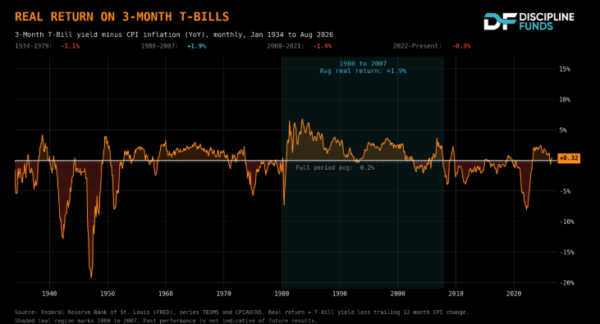
A generation of savers anchored to that 27 year run and came to see it as normal or deserved. It wasn’t. It was just the anomaly in a long history of negative real returns on cash.
Rates are set, not discovered
My original piece argued that low rates reflected weak productivity, as if the economy had simply stopped earning enough to pay savers. That is, ironically, loanable funds thinking (something I have always argued against), and it doesn’t describe how interest rates actually work.
The short-term risk free rate is set by the Federal Reserve. It’s the most direct lever monetary policy has. When the Fed wants rates at 5%, they’re at 5%. When it wants them at zero, they’re at zero. Productivity, demographics and growth influence the Fed’s decision, but the rate itself is an administered price. The Fed can set it at whatever they want and their bottomless barrel of reserves is not something that “bond vigilantes” or anyone else can compete with. They are the ultimate price setting monopolist and the only thing that can buck them off a strongly held view is inflation. Inflation, after all, is the thing that can always make any politician or Central Banker bend the knee.
Warren Mosler took this idea of 0% rates to its logical conclusion. In a 2005 paper with Mathew Forstater, he argued that the natural, nominal, risk free rate of interest is zero under contemporary institutional arrangements. The logic is pretty simple once you see it. When a government that issues its own currency spends more than it taxes, it adds reserves to the banking system. If nothing else happens, banks compete to lend out those excess reserves and the overnight rate falls toward zero. If the central bank wants a positive short-term rate, it has to either pay interest on excess reserves or drain them through bond sales. That’s why QE required interest on reserves – because all those reserves made the overnight rate collapse to 0% and the Fed had to lift the rate off the floor to ever make it positive.
That’s essentially how the Fed has operated since 2008. It pays interest on reserves to hold its policy rate wherever it wants it. So any positive return on T-Bills isn’t something the economy “earns” for savers. It’s a policy decision to pay them. You could argue it’s indirectly influenced by the economy via inflation and nominal growth, but it’s not a price that is set by the bond market or anyone’s demand for deposits.
Risk free depends on your time horizon
This is the part I underplayed the first time, long before I had fully developed the asset-liability matching models I now utilize. A 3-month T-Bill is risk free over 3 months. That’s it. If you need money in 10 years and you hold nothing but T-Bills, you’re taking real risk. You’re exposed to whatever the Fed decides to do with rates over the next decade, plus inflation. The risk free asset for a 10-year liability looks more like a 10-year TIPS than a 3-month bill.
So the question “do savers deserve a risk free return?” really depends on which risk free asset you mean. Cash exists to give you certainty and liquidity for near-term needs. It’s the right tool for money you’ll spend in the next year or two. Expecting it to also deliver real growth is asking it to do a job it was never designed for. But overnight money is risk free in large part because you don’t have to do anything to earn its safety. Risk assets, like stocks, pay you a premia precisely because they compensate you for a specific temporal risk.
The savers who got hurt were mismatched
This was a footnote in the original, but it should have been the whole point of the 2016 piece. Savers who got hurt by low rates weren’t victims of the Fed or banking system. They were holding zero-duration assets against long-duration goals. Someone with a 20-year retirement horizon sitting entirely in T-Bills was always going to have a problem. Zero rates just made the problem obvious.
If you match your assets to when you actually need the money, the rate on cash matters a lot less. Short-term needs go in short-term instruments, where certainty is the whole point. Longer-term needs go in assets with longer durations and higher expected returns. Rate cycles will come and go based on policy choices you can’t control. Your time horizons and liabilities are something you can control.
So no, savers don’t deserve a risk free return. But savers who allocate by time horizon never needed one.
References
- Forstater, Mathew and Warren Mosler. “The Natural Rate of Interest Is Zero.” Journal of Economic Issues, Vol. 39, No. 2 (June 2005), pp. 535 to 542.
- Federal Reserve Bank of St. Louis, FRED: TB3MS (3-Month Treasury Bill Secondary Market Rate) and CPIAUCSL (CPI for All Urban Consumers).
- Dimson, Marsh and Staunton, UBS Global Investment Returns Yearbook (long-run real returns on US bills).