

The headline isn’t clickbait. It’s true. But you’re probably not gonna die from the things the financial media says are scary. Here are some of the financial causes of death I think I am thinking about this week.
1) AI is going to kill everyone, right?
The talk of the town this past week was all about how AI is going to kill everyone. The big AI companies agreed to slow the progress in model development because of some worrisome events in which the AIs appeared to be doing things on their own and against the wishes of the companies building them. It was a sort of Skynet moment from Terminator 2 in which the system became self aware. How concerned should we really be about this and what can we do?
This is a tough one. On the one hand, I think the concerns are legitimate. On the other hand, I don’t know who better to charge ahead with this than the Americans? Because someone is going to charge ahead with this technology and if anyone is going to make the best version of it then why shouldn’t it be us? There’s a bit of a Manhattan Project going on here. If the Germans had gotten the bomb first we’d all be Germans. But the Americans got it first and even though that technology is the deadliest ever created the Americans have used it in a very responsible way. AI is similar in my mind. Should we really follow the Bernie Sanders path here, make development of it completely illegal and then find out in 5 years that China and Pakistan developed the leading versions of it? Versions that, mind you, might not be used in the most moral ways? And then the American versions will all be behind and their super intelligence will outsmart our super intelligence and who knows where that ends up. The point is, it’s gonna get produced so why would we stop that innovation?
I think it’s good to proceed cautiously, but we can’t stop living and so the response can’t be to bury our heads in the sand or crawl into a hole because this technology is coming whether we want it or not. So, what am I doing? Well, first I am being very cautious about how it can intrude into my life. Anything that is financially sensitive doesn’t just require 2 factor authentication. It requires third party authentication. You can’t be cautious enough with sensitive information that could be easily hacked into. And then from an investing perspective I think the best solution to insulating yourself is to be broadly diversified or diversified entirely away from technology. In the Defined Duration strategy technology currently has a 30+ year defined duration. It’s an asset that could generate extremely high returns, but will do so with much higher sequence risk than something like domestic value stocks. So if this stuff really worries you then you need to take the right safety measures to secure your sensitive information and diversify your portfolio in ways that it cannot harm your portfolio. Personally, I am optimistic about AI, but I am also treating it like a super long duration asset. So it’s matched to my very longest assets like a Roth IRA or multi-generational planning. What it will do in the near-term is anyone’s guess and no one really knows.
2) The bond market is going to kill everyone, right?
I was in Huntington Beach this week for the Future Proof conference, which, by the way, is the absolute best financial conference around (low barrier, I know, but this one is great so go next year if you’re an advisor). I joined Mike Batnick and Ben Carlson on stage to discuss the worries about US government debt and the risk of a “debt heart attack” as Ray Dalio refers to it. You can watch the full video here (my segment starts at the 31 minute mark).
This is similar to the comments I made last year when Dalio was pushing this view in the FT (he has 2 years left on his prediction by the way). I tried to emphasize here that you can’t generalize about this topic because that creates an irrational view of the entire bond market. For instance, Dalio is simply wrong on the mechanics when he says default is a concern in the USA. He consistently compares the USA to a household or business, but this is a completely false analogy. No business or household has a printing press or the ability to tax the wealthiest society that ever existed. So the notion of default is just wrong, especially since we don’t borrow in a foreign currency. But let’s give him the benefit of the doubt and assume that the “heart attack” he’s referring to is an inflation heart attack. In this case you just need to be careful about how you’re getting your exposure because the nuance matters. This distinction matters because when default is the risk then ALL of the debt is bad. But if inflation is the risk then different debts have different risks.
I was cited in a CNBC article this week discussing the importance of what I refer to as “escape velocity” in bonds. I spoke with the author, Cheryl Munk, for an hour about this topic this week and she did a brilliant job of summarizing it:
Roche developed a tool to identify the point on the government bond yield curve where the bond yield equals its modified duration. At this point, one year of interest income offsets the price decline from a 1% rise in rates. The bond breaks free from rate risk over the same period in which it earns its coupon. With rates where they are today, “anything five years and lower, you have a cushion. Anything higher, you have less and less of a cushion,” he said.
Bingo. Modified duration is the interest rate sensitivity of the bond’s price. So, if a 5 year bond has a duration of 4.8 and rates go up by 1% then the coupon of the bond, at 5% today, will completely offset the price decline. But if you buy a 30 year T-bond with a duration of 16 then that bond, which is yielding just 5.3%, will fall 10.7% if rates rise by 1%. You have a lot more principal risk in that bond because its annual coupon doesn’t offset its duration. And this is critical in understanding how you’re currently taking risk in bonds because if inflation goes much higher and you own a bunch of long duration bonds then you’re going to get whacked. But if you insulate yourself in the 0-5 year bond segment then you’re pretty well insulated from any significant principal risk. This is even truer of things like 5 year TIPS which are yielding 2.5% real.
In short, yeah, if inflation goes up then certain types of bonds will kill you. But if you’re funding short duration liabilities then Tbills at 4.5% and anything out to 5 year TIPS at 2.5% looks pretty attractive and with fairly insulated inflation risk as well.
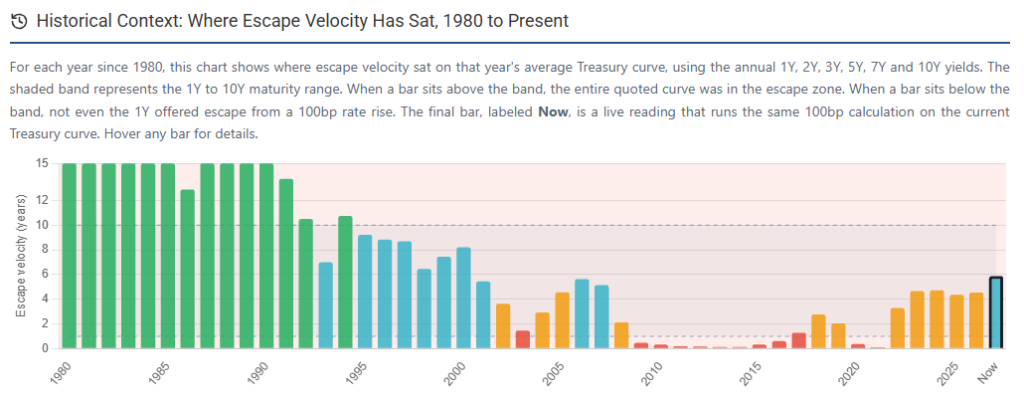
Oh, and if you haven’t already, check out the escape velocity tool here. It will show you the current and historical EV and what’s cool about this concept is if you’d been following it during the last 40 years you’d have loaded the boat with long bonds in the 80s, dialed down your average maturity over time and you’d have held nothing but short duration bonds in the 2010s. The current level is the most attractive we’ve seen since the year 2000.
3) Rate hikes are going to kill the economy, right?
Well, that was a surprise. I’ve been on record most of the year saying they wouldn’t hike interest rates. And this week the Federal Reserve raised interest rates. My logic (or illogic I guess) was that Trump wouldn’t push the war in Iraq so all the headline inflation we’re seeing is controllable from the White House. And the President surely wouldn’t press the matter into the mid-term elections, right? I mean, it would be crazy to start a meaningless war in Iran and push diesel prices to $8, crude to $100 and unleaded to $5. Those are Covid inflation numbers. You’d get your butts kicked in the mid-term elections if that happened, right? But here we are. This conflict just won’t go away and now we’re paying the price with rising inflation and surging mortgage rates again. I am shocked that the White House keeps pressing the matter. And I can’t say that I disagree at all with the rate hike decision at this point. If this war is going to persist then the Fed needs to dig its heels in for the potential world where oil is $200 and you get a massive cost push inflation effect in the years ahead. It seems crazy that all of this is happening but it is so the Fed needs to be prepared for any and all outcomes.
Now, you might argue that interest rates are the wrong lever to fight that battle and you’d probably be right. After all, we’ve already crushed the credit markets with the recent rate hikes and the mortgage market is frozen. I don’t think another 25 bps or even 100 bps in rate hikes is going to have a material impact on credit at this point and that is the primary way rate hikes impact the economy. What matters most at this point is oil and commodity prices and rate hikes don’t have a direct transmission mechanism to impact those prices. So the guy who has the most control over those prices at this point is in the White House and he doesn’t seem especially eager to get oil prices down.
So far the economy seems to be holding up just fine under the higher oil and gas prices.
Well, that’s all I’ve got for you this week. I am off this weekend to venture into the boiling hot El Nino waters of Mexico for an annual fishing trip. I’ve been told by the wife that if I don’t bring home a bluefin tuna I’ll be the sashimi so wish me luck. As always stay disciplined out there.