

Here are some things I think I am thinking about.
1) What are we doing with this war?
This has gotten very interesting. As I mentioned in our last update, none of this is great, Bob. And the longer this goes on the worse it seems to be getting. It reminds me a bit of last April when the tariffs were initially proposed as being humongous. I said the longer they remain in place the worse it all will get. Of course, the tariffs never ended up being as large as initially proposed (not even close) so it was a short-lived panic. Are we going to see the same thing here? I don’t know because this one is harder to pull out of.
But the more interesting question in all of this is “what are we even doing here?” There’s a narrative that the Iranians were on the precipice of having a nuke. But dropping bombs in Iran doesn’t only hurt Iran. As we see with oil and inflation expectations it’s hurting the US economy in a very meaningful way. I think the White House wants to hurt Iran in the long-run even if it hurts the US economy in the short-run. Again, it’s not dissimilar to what they were saying last year with the tariffs and how they might require some short-term pain for long-term gain. The problem here is that tariffs are just contracts that can be ripped up and thrown in the garbage whereas blowing up parts of the most essential global energy supply can’t just be repaired overnight. And that’s what is starting to bleed into the economic data and inflation expectations.
The move in rates on Friday was pretty jarring with the 10 year jumping to 4.4%. We could be looking at 7% mortgage rates before long. And the national gas average is almost certain to hit $4 next week. Housing was already in the toilet so this is the last thing it needed. And the hit to gas will bleed into consumption. We haven’t started to see a material impact in employment data, whether it be our FICA tracker or employment claims. But these are things we should keep a close eye on. The longer this goes on the more probable it becomes that this spirals into recession talk.
On this front, the best thing I’ve listened to is this Odd Lots interview with Greg Brew from Eurasia Group. It will put this entire event in good perspective. In short, the Iranians are willing to wait this one out no matter the cost and they’ve got the geographical advantage to make this a very long and drawn out mess that has a lot of corollaries to the Vietnam war. A wise man once said “never get involved in a land war in Asia”. We’re not there yet, but it looks increasingly likely.
2) Where is inflation going now?
In the span of three weeks the market went from expecting 3 rate cuts in 2026 to now expecting a rate HIKE. That’s incredible. 1 year inflation breakevens have exploded to the upside in the last month as headline inflation expectations shift in response to the shock. But how high could inflation go and how much does this damage the Fed’s ability to stimulate the economy?
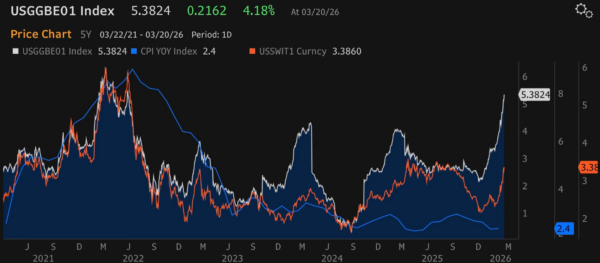
As I noted last week, the labor market will still play the bigger role here. The oil shock has to be viewed as the more temporary event in the scope of the current environment and with weakening labor data that is a more structural problem as AI begins to have a more meaningful impact. But the oil shock is going to force the Fed to hold even if the labor market is softening further. The accompanying chart and 1 year breakevens is alarming, but you need to be careful with such a short-term indicator of inflation changes because breakevens are typically much more volatile than actual CPI. Still, this shows how much near-term expectations have shifted and could foretell a more permanent change in expectations. In other words, the longer this plays out the worse this all gets.
That scenario kind of reminds me of Covid where the Fed initially expected the supply shock to be “transitory”, but as Covid lingered it became a much more permanent looking shock. There are scenarios, albeit unlikely, where something like that plays out here and you get a self imposed 1970s style inflation because this lasts for a long time.
Here’s the problem and how I see various oil scenarios bleeding into headline CPI:
$100 oil for 3 months: this results in 3.5% headline CPI. This is a bad scenario and forces the Fed to hold through the year.
$125 oil for 3 months: this likely results in about 4% headline CPI. This puts the Fed in a serious bind, where, even if labor is softening a lot, they are having a tough internal debate and likely have to hold.
$150 oil for 3 months: this results in 5%+ CPI and the Fed is likely talking about hikes instead of cuts, no matter what is happening with the labor market.
In my view these are all bad scenarios compared to where we were just a few weeks ago. We had finally gotten mortgage rates below 6%, gas prices were under $3 and things seemed generally okay.
I struggle to see how this can last more than 3 months mainly because the USA will be in a recession by then and if that were to materialize it would be viewed as the biggest economic own goal in US history. The criticism would be beyond deafening.
So, what is the Fed going to do? They’re going to say “why did I sign up for this job again?”
3) What are we doing with our money?
The bad news is that all of this is troubling in the short-term. The good news is these big geopolitical events tend to be relatively unimpactful in the long-term. So, if you’ve got a long-term perspective and you’ve matched your assets and liabilities correctly, this shouldn’t really be altering your plan at all. That said, stocks are down 8.4% and bonds are down 2.5%. Those aren’t huge numbers, but they could be altering the way you’re thinking about investing new cash.
So, stocks have become a little more inexpensive with long-term money. And cash and short-term bonds have also gotten more attractive for short-term money. T-Bills are almost back to a 4% yield after dipping to 3.5% earlier this year. So there’s a silver lining in all of this regardless of your time horizon – both stocks and bonds have gotten a lot more attractive in the last few weeks. That doesn’t mean they can’t get a lot more attractive (this is a gentle way of saying this could all get a lot more scary), but again, when time is your strategy, timing the market becomes a lot less relevant to your financial plan. It’s probably the main reason I love the Defined Duration strategy. Events like this should not materially alter your short-term view on anything because you should have more than enough short-term assets to ride out storms like this.
In more related, but equally important news, it’s that special time of year where you are supposed to be working on your Spring garden like I am. If your lawn is looking brown this is a good time to be pulling weeds and reinvesting in it. As I said in the new book, when someone else’s lawn is looking greener than yours you don’t sell yours and buy theirs. You just need to tend to yours knowing their lawn might be on the verge of changing colors sooner than later. There’s a metaphor in there for what’s going on in the economy and markets at present. Personally, I spent two hours at Home Depot this morning reinvesting. I hope you spent your weekend doing something equally wonderful.
As always, stay disciplined out there.