

Here are some things I think I am thinking about over the long weekend.
1) Goodbye, Greg.
I lost one of my very first clients recently. His name was Greg and he was an amazing guy. When I had my first daughter Greg and his wife Pam sent me 5 children’s books. They’re those kind of people – the type who send their financial advisor a gift. There are really good people and then there are people like that. I wish I was more like Greg.
Greg had an advanced form of Leukemia that we thought he’d beaten 6 months ago. I spoke with him just 2 weeks ago and he sounded and felt great. And then I got the email from Pam. Man. That was a bad day. I handle these cases a lot in my work – I guess I am just young enough that people think I’ll be around for a long time and just old enough to be trustworthy with someone’s succession planning. But it never gets any easier when it happens.
It reminded me of an important estate planning reality that a lot of people overlook – dying is expensive. When someone passes away the family has an immediate liquidity crunch. It’s terrible. All you want to do is mourn the person you just lost and you have to worry about money. But can you even access the money? Is it liquid? Do we have enough? It can take weeks or months to get a death certificate to process beneficiary transfers and if you don’t have joint or estate accounts set-up correctly there might be money for this liquidity crunch and you might not have access to it. So here is a short list of things that can really help:
A. Update trusts, wills and estate plans so trusts are funded and joint accounts are established for ease of access in case of a succession event. A lot of people don’t know that you can make a bank account a payable on death account essentially creating a beneficiary in a taxable account. Do it.
B. Doublecheck beneficiaries and contingent beneficiaries. Custodians can’t legally process transfers until death certificates are issued so keep that in mind in case you need to transfer accounts.
C. Ensure immediate liquidity. Everyone should have an emergency fund. Not just in case you lose your job or something else happens. You need it in case of a sudden liquidity trap like death.
This is all just one more reason why I have become so obsessed with time weighted strategies in investment management. When time is properly accounted for the investment portfolio aligns perfectly with these sorts of financial planning needs.
Anyhow, the world is a better place for having had Greg around for 50+ years. Rest easy my friend.
2) Wait a second – is AI inflationary?
There are a couple of interesting things going on with inflation and AI. The obvious one is electricity prices, which have been running at 6%+ in the CPI for the last few years. And then there are surging prices in things like memory and chips which were deflationary for decades before AI came along. And now we’ve got the messiness of the Iran war on top of all this which, combined with the AI narratives, is creating a real problem for inflation watchers. What’s going on?
Well, first of all, we have the obvious surge in oil and energy from the self inflicted invasion of Iran. Headline CPI is gonna come in at 4.18% or so in May. That’s bigly. Then again, core is expected to come in at 2.82% which isn’t the end of the world. In fact, that’s not that far off from historical averages. But it’s certainly high compared to where expectations were just a few months ago. With gas prices still running well over $4 a gallon you can expect the inflation effect to linger here. It will probably be a problem for the remainder of 2026.
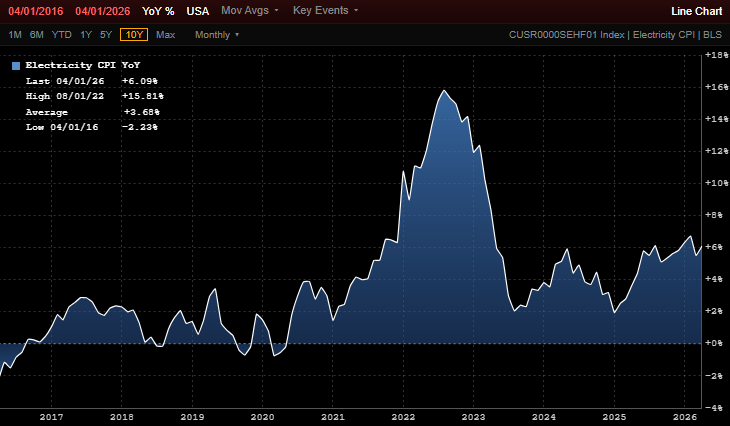
But here’s the thing with AI specifically – I think you have a two phase process going on here. Phase 1 is the AI buildout. The technology is evolving so rapidly that it’s hard to keep up. And so firms are just throwing huge amounts of money at this trying to catch up. This is combined with a huge wealth effect because the productivity gains and margin improvements are getting priced into the market. All of this creates a near-term surge in prices in various ways. Phase 2 is the AI productivity boom. As we transition into phase 2 the capex boom will slow and the results will start to really become obvious. Unit labor costs will fall and the long-term impact becomes clearly disinflationary as AI makes firms more efficient and competitive. At some point we’re going to have robots making virtually everything 24/7. One day you’ll wake up and drive (in a robotic car) past a construction site with a human General Contractor and 5 robot workers who don’t take breaks, don’t get tired and start hammering at 7AM on the button and don’t stop until 7PM when the local regulators require noise compliance. That’s a world of abundance and efficiency that will have a massively disinflationary effect on almost everything.
Of course, a lot of that is far off, but I am not sure just how far off. I was mesmerized watching this live stream this week of a human box sorter competing with a robot. It’s happening people. The robots are coming. So, I don’t think it’s a matter of if Phase 2 comes. It’s a matter of when. But yeah, it looks like 2026 is going to be another year of inflation troubles and AI isn’t helping us there just yet.
Sidebar – someone asked me recently “if you’re so bullish on AI then why is the Defined Duration strategy bearish on technology and growth in general?” I am not pessimistic about growth and technology at all and I don’t think it’s right to say that a DD approach means owning no growth. You see, the Defined Duration strategy is designed to establish certainty around very specific time horizons. Someone who’s drawing down their portfolio in retirement needs monthly liquidity. You can’t match that liability to AI stocks. That would be irresponsible. You match it to T-Bills or something cash equivalent. But if you’re a 25 year old with a decent income and you have a Roth IRA that you’re not going to touch for 50 years then you should probably be loaded to the gills with technology and growth because that time horizon matches nicely.
The thing about current stock market valuations is that they create a lot of sequence risk. So, if you had a portfolio with a lot of equities and you’re very concerned about the path of your returns then owning a lot of technology introduces more potential sequence risk. A value portfolio has a Defined Duration that is much lower than a technology portfolio because the expected returns and risk in technology are higher. And if you get lower returns in tech for some reason then your sequence risk is going to be a lot higher along the way. You can mitigate this by reducing your exposure to AI. Some people might scream “that’s active management”. I call it good asset-liability matching and customization. It’s really got nothing to do with “activity” in the sense of trying to actively beat the market. The point is, you don’t need to be bearish technology in this environment using a Defined Duration approach. It just means you need to compartmentalize those assets in a much longer-term bucket that properly insulates you from any near-term shocks.
Sidebar 2 – another question I am getting a lot these days is “does the SpaceX addition to the S&P 500 worry you?” I guess it depends. Like I was discussing above, technology has a lot of potential sequence risk these days because valuations are so high. But it also depends how you end up getting exposure here because the different indices have different rules for inclusion. It looks like funds like VTI (Vanguard Total Domestic) will include SpaceX very early. The S&P 500 and Nasdaq 100 will likely own it, but the timeline is likely longer.
In addition, the weightings in each index are going to be very different. For instance, VTI weights its holdings based on free float outstanding. If SpaceX has 4% of shares available then the $1.75T market value is only applied in the index as a $70B company. That’s going to be a tiny weighting (maybe 0.1%) in the total index. But with SpaceX’s accelerated insider trading plan the weighting likely increases to 0.5% by month 6 or so. The Nasdaq 100 has a different approach here. They’re actually allowing “fast entry” exception with SpaceX where a tiny float can still be weighted up to 3X its actual size. That means SpaceX could be a much larger part of the Nasdaq 100 by month 6.
More importantly, if you’re worried about timing the market like this then you should probably adhere to what I discussed above and make sure your equity components are compartmentalized properly. If you’re very value sensitive and sequence aware then you probably need to be overweight foreign and domestic value in an environment like this. If you’re worried about stocks like SpaceX, which will probably have a PE ratio of 80+ when it debuts then you need to think about that type of asset as a totally different time horizon in your portfolio.
3) Are you overinvested in Bonds?
This was an interesting article in the WSJ a few days ago in which MIT’s Robert Pozen argues that most people are probably overweight bonds. Pozen is the former Chairman of MFS Investments, a $650B firm, so he knows a thing or two about this stuff. He attacks the conventional wisdom in many age based investing strategies such as the age in bonds rule or the age minus 10% in bonds. I think Pozen is right, but I am not sure I totally agree with his conclusion.
The way I think about this from an asset-liability matching perspective is that your bond allocation should be completely needs-based. That’s what HourglassFP Pro does – it doesn’t quantify your bond allocation based on some subjective risk profiling process. It actually quantifies the health of your income statement and balance sheet and then spits out a bond allocation based on your financial planning goals. Everything else gets pushed into longer and higher expected return generating instruments. For instance, if you’re 65 years old and you have $2MM to invest and you have a $50K shortfall between expenses and Social Security then you have about a 2.5% withdrawal rate. HourglassFP will output about 2 years of expenses into TBills to help you fund near-term withdrawals and then about another 200K in short-term bonds. The rest gets pushed into longer-term instruments where your equity allocation is about 65%. That’s 10%-20% higher than what the age based rules say to do. And that makes a big difference because this investor is covering their financial needs AND taking more risk because they have the capacity to do so. They’ll be better off in the long-run because they took more risk while also having a sufficient buffer in liquidity instruments to ride out some storms. This approach quantifies your bond allocation based on your financial health, not your age and emotions.
Now, what’s interesting about using a risk capacity based approach is this – if this investor has $5MM then their risk profile is actually completely different because their coverage ratio is completely different. While investor A has $2MM and a $50K annual shortfall with a 2.5% withdrawal rate the $5MM investor has a 1% withdrawal rate. Their capacity to take risk is higher because they have a healthier balance sheet relative to their income statement. It doesn’t matter what their age is. The wealthier investor should push more assets into riskier instruments because they don’t need as much near-term certainty. In the case of our HourglassFP output you actually end up with 74% in equities. This investor has over 400K in Tbills and another 400K in short-term bonds, but even though they’re holding more short-term reserves their overall portfolio is riskier because their risk capacity is higher.
You could argue that this is often worse with young people. Many retirement plans use a glidepath approach that doesn’t assess the investor’s personal situation at all. For instance, you might be 25 years old with a high and stable income and a Target Date Fund approach will throw you into something like 85/15 stocks/bonds. But you have the equivalent of a synthetic bond allocation in your income and the 15% bond allocation in your 401K isn’t even something you can touch in the short-term. It’s a 5 year instrument (or something similar) in a 40 year account bucket. That makes no sense as the bond allocation is serving virtually no purpose in your plan aside from some vague behavioral buffer. You need to drill down into this so it’s customized at the account and personalized levels.
So, I would generally agree with Pozen’s conclusions. You probably own more bonds than you should because the old math in portfolio construction is wrong. Age based glide paths are lazy heuristics that don’t drill into the customization of personalized risk capacity. And if you use a risk capacity based approach you arrive at totally different conclusions than age based rules – conclusions which I believe will generate better outcomes.
Well, that’s all I’ve got for now. Happy Memorial Day everyone. As always, stay disciplined out there.