

Here are some things I think I am thinking about this weekend.
1) Warsh Wins the Fed Nomination.
Donald Trump officially announced that Kevin Warsh will be his nominee for Fed Chair. Last week I’d expressed my excitement over Rick Rieder’s surging probabilities, but it wasn’t to be. I have a sort of mixed view on Warsh.
Warsh is a strange pick in my opinion as he’s one of the most hawkish economists around. There’s no doubt he’s informed Trump that he wants to cut rates more, but historically speaking, this isn’t someone who likes to use the Fed’s tools to pump the economy (which might be a good thing, as I describe below). Warsh has a history of being persistently concerned (and wrong) about inflation, sometimes at the worst possible times imaginable. For example, in mid 2007 he was very concerned about rising inflation when we were on the precipice of the biggest deflationary collapse of the last 75 years. He repeated this concern during the Summer of 2008. And then, as late as September 2008 he was still saying inflation is the primary problem even though commodity prices had fallen 30% at this point and we were very obviously in the throes of a debt deflation. And even after inflation had collapsed in 2009 Warsh remained hugely concerned about it. In the years immediately after the GFC he was concerned QE would contribute to inflation and that the zero interest rate policy was too stimulative at that point. But the rate of core PCE inflation didn’t get consistently above 2% until Covid!
At the same time, there’s no doubt that Warsh is not only qualified, but incredibly sharp. His resume is impeccable. I love that he has significant experience, especially during a crisis. And in fairness to his inflation predictions the GFC was an incredibly difficult time to predict anything and in the end he did end up voting in favor of the supportive policies that helped us sidestep something much worse. So even though he was concerned about inflation he was willing to let the committee influence his strong views in favor of compromising. That says a lot about how he’ll lead the Fed. It won’t just be the Kevin Warsh show.
Another thing I like about Warsh is his view that the Fed shouldn’t be the backstop for every single little problem that goes on in the economy. And I can’t say I disagree with that at all. I do like the idea that we should rely less on the Fed and not feel the need to take action every time the S&P 500 falls by 15% or interest rates get a little jittery. So, while I thought Rick Rieder would bring a much needed real-time market-based view to the FOMC, I also don’t think it’s bad that Warsh will bring a more free market view to the FOMC.
In short, I can’t say that I feel strongly one way or the other about this one. But if he can commit to remaining independent of political influence then I don’t see a strong argument against his nomination.
2) Thinking About Price Compressions and Sequence of Returns Risk.
One of the things I talk about in my new book is the concept of “price compression”. That’s basically the idea that extreme price changes are best viewed thru a temporal lens. For instance, in my recent interview on Odd Lots I talked about how the price of gold is currently experiencing an extreme price compression where the return has averaged 9% over the last 20 years, but then in 2025 alone it went up 65%. So you get 7 years worth of returns all compressed into one year. The price compresses.
What this does is it creates more sequence risk. It doesn’t mean that prices have to be negative in the future. But it does mean that the sequence of returns in the future will be significantly more volatile and so your risk adjusted return ends up being far worse. And so it doesn’t surprise me to see events like Friday where the price of gold craters 10% in a single day and the price of silver collapses 30%+. You’re seeing significantly higher sequence risk because of the prior price compression. Of course, the hilarious part in all of this is that silver is still up 19% year to date. How can you not love markets?
We typically only talk about sequence of returns risk in the context of retirement planning when you’re drawing down a portfolio and worried about large portfolio declines. But it’s a concept that everyone is worried about even if they don’t think of it in the academic sort of way. Because everyone is concerned that their portfolio will decline in some extreme event that could force them to change their consumption habits. This isn’t only an income vs portfolio problem as the academic concept implies. Sequence of returns risk is something that everyone should be more concerned about. And that’s just one more reason why I love the concept of Defined Duration Investing and structuring your portfolio across very specific temporal pools of assets. In doing so you’re not only creating a diversified portfolio, but you’re creating a temporally diversified portfolio where you’ve very intentionally reduced your sequence risk because you’ve structured your portfolio using assets that have different inherent sequence risk inside of themselves.
There are so many price compressions going on these days that it’s a very difficult time to invest. Do you chase the Mag 7? Do you chase precious metals? Do you chase Bitcoin? The good thing is, you don’t have to worry about timing the market when your assets are specifically time weighted.
3) Are Commodity Prices Going to be a Problem for the Fed?
This has gotta be the chart of the month so far. The Bloomberg Spot Commodity Index is up 22% year to date, even with the massacre in metals on Friday. I am not sure exactly what’s been driving this surge, but it has the potential to throw a wrench in any rate cutting plans in 2026. After all, if this persists then it will show up as a higher price level in future CPI reports. And inflation has already been somewhat sticky. So this will only exacerbate the risk of more stickiness in the year ahead.
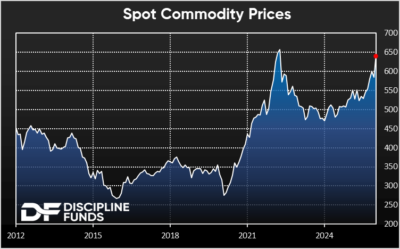
It’s something I’ve been talking about a lot in recent years in the context of housing. Shelter inflation has been a huge headwind to a resurgence in inflation because the shelter component is so large that you need something else to be a huge offset to actually get high inflation readings. Shelter has been so soft that it acts like a huge drag on the overall readings. I’ve noted that an inflation environment like the 1970s can only persist if you get huge changes in things like commodities. Oil, for instance, went from $3 to $30 over the 10 year period in the 70s so if you got something like that it would act as a huge offset to weak shelter. That might not cause a 70s style inflation, but it would definitely get inflation high enough to make the Fed very uncomfortable.
Before the last few months commodities had looked pretty flattish for the most part. So this is something that’s going to be worth keeping an eye on. If we get a more persistent trend in higher commodity prices then you’re going to see the back of the yield curve under a lot of pressure and you might even get a Fed that has to start communicating a much more cautious and hawkish tone. The real Kevin Warsh might have to stand up in that environment and that’s a Fed Chief that the stock and bond markets will not like one bit.
NB – I’ve been on a bit of a media world tour in the last few months so if you’re not interested in buying the book you can catch some of my recent interviews on it. Here are a few of my favorites: